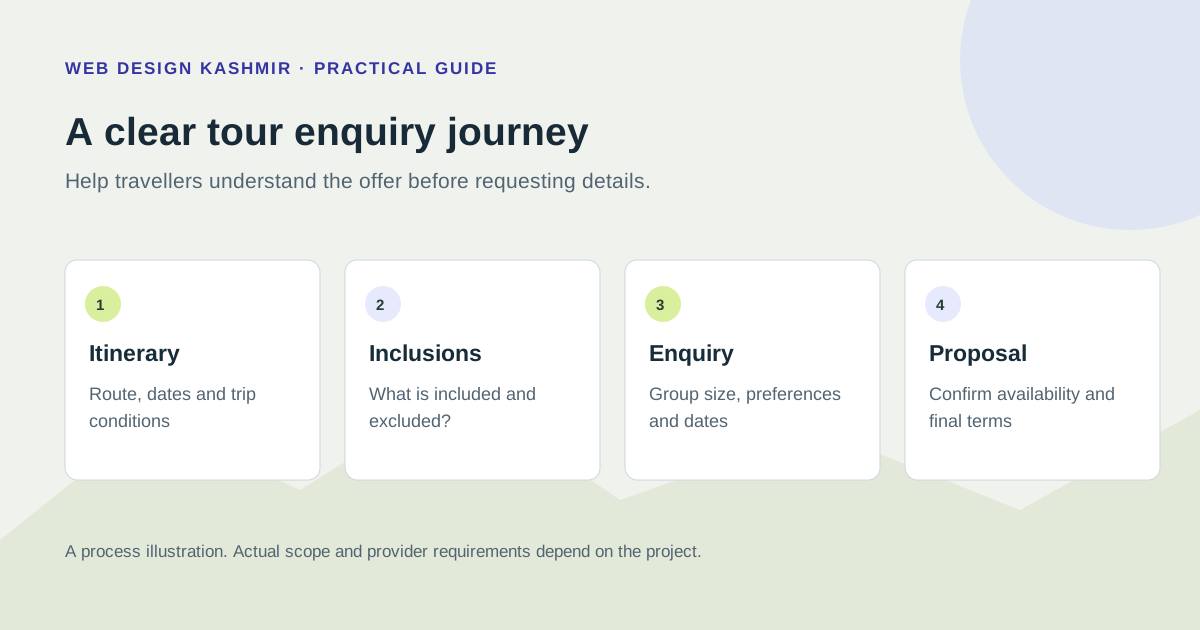
1. Decide what the direct channel should do
A tour operator may receive leads through partners, marketplaces, social media, referrals and an owned website. Compare these channels using your actual cost and enquiry quality. Do not assume every third-party lead is shared or that a direct enquiry automatically has a higher margin.
Choose a realistic first goal: help customers compare a few well-described tours and submit a usable request. If prices depend on hotel availability, vehicle choice and travel dates, a reviewed quotation may be more reliable than a supposedly instant final price.
Track the source of an enquiry, whether the customer is reachable, whether the requested dates can be served and whether a proposal becomes a confirmed booking. This makes marketing decisions more concrete than counting every WhatsApp click as a sale.
2. Give each tour page the information buyers need
| Information | What to explain |
|---|---|
| Route and duration | Day-by-day destinations, overnight stops and the intended pace. |
| Inclusions | Accommodation category, meals, vehicle arrangements and any included activities. |
| Exclusions | Items charged separately, optional activities and personal expenses. |
| Price basis | Per person or group, occupancy assumption, date validity and applicable charges. |
| Practical constraints | Season-dependent access, travel time assumptions and what can change. |
| Terms and contact | How availability is confirmed, payment schedule, cancellation terms and support. |
Use photographs you own or are licensed to use. Describe accommodation accurately; do not show a premium room as though it is included in every package. If the final hotel can vary, explain the selection and confirmation process.
Review travel details with the operator responsible for delivery. A designer should not invent route timings, access permissions or seasonal safety assurances simply to fill a page.
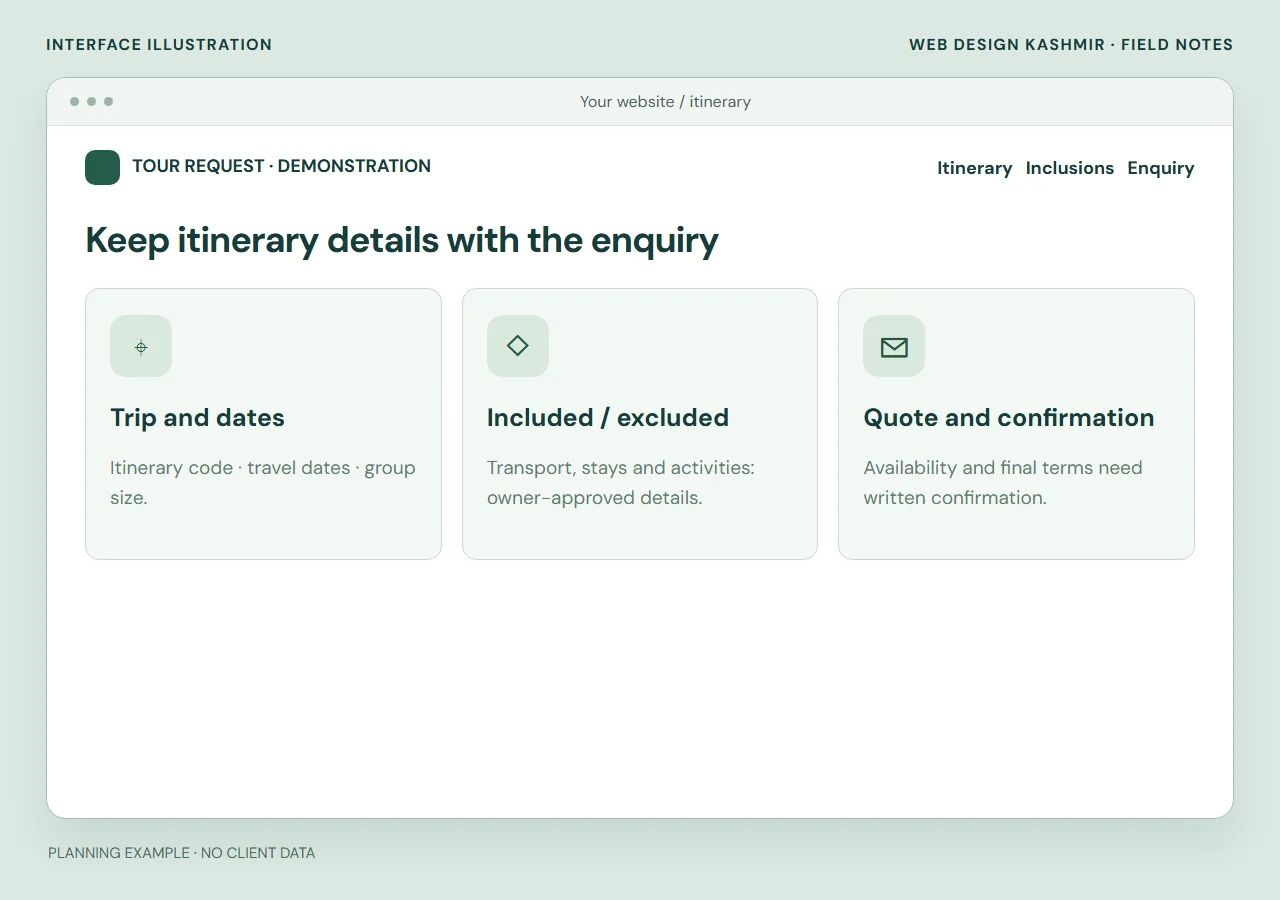
3. Build a quotation process with clear assumptions
An itinerary request can collect dates, group size, preferred destinations, accommodation preference and a contact method. Ask only for what is needed at that stage. Avoid collecting identity documents in a general lead form.
If an estimator is provided, show whether it is indicative and explain which variables require staff confirmation. Keep prices and rules maintainable from an admin system or a documented source rather than hard-coding dozens of inconsistent package prices.
- The traveller submits the core request.
- The operator checks availability, route feasibility and supplier rates.
- The customer receives a written quotation with inclusions, exclusions and validity.
- The customer agrees to the terms and follows the approved payment process.
- Staff confirm the booking and communicate any subsequent changes.
Keep an enquiry reference so staff can connect a conversation to the original request. A clear status such as “awaiting availability” is better than implying a booking is confirmed when no inventory has been secured.
4. Make WhatsApp useful without losing the request
A click-to-chat link can prefill the selected package and a short request. It should still work if the traveller does not complete a long form. Provide an email or form alternative for someone who does not use WhatsApp.
Example message: “I am interested in the Srinagar and Pahalgam itinerary. Travel month: __. Travellers: __. Please confirm availability and what is included.” Avoid putting sensitive personal data into a URL, analytics event or public message preview.
State your actual response hours and assign someone to monitor requests. A website cannot guarantee a response in two minutes unless the operating team can provide it. Automatic acknowledgements should explain that a person will check the details rather than pretend to be a confirmed quotation.
For automated messaging, confirm the current platform requirements, consent and template arrangements with your chosen provider. Keep a record of customer preferences and stop unwanted follow-ups. A simple reliable workflow can be more useful than an unmaintained integration.
5. Compare channel economics using your own figures
Use actual partner contracts and fulfilled bookings. Include acquisition cost, payment charges, staff time and refunds alongside any commission. “Zero OTA commission” describes only one type of charge; it does not mean the direct booking has zero cost.
| Measure | How to use it |
|---|---|
| Cost per qualified enquiry | Channel spend divided by enquiries that match services and can be contacted. |
| Proposal conversion | Confirmed proposals divided by qualified enquiries for the same period. |
| Contribution per booking | Revenue less supplier, fulfilment, payment and attributable acquisition costs. |
| Cancellation effect | Track refunded or cancelled bookings separately from confirmed sales. |
As an illustrative worksheet, compare a direct enquiry channel and a partner channel over the same travel period. Use completed bookings rather than unverified lead counts. A small sample or a seasonal change can make percentage comparisons misleading.
6. A worked itinerary-page acceptance test
This is a planning example, not a client case study. Suppose your page offers a five-night tour with stays in Srinagar and Pahalgam. The page should say which nights are where, how the price is calculated and what requires confirmation. A visitor should be able to identify exclusions before sending a request.
Test the page with a family travelling with a child, a couple requesting a different hotel category and a group asking for an arrival outside normal pickup hours. If the form cannot express those needs, provide a notes field or a clear alternative contact route.
Then test an amendment: a date or guest count changes after quotation. Staff should produce a revised offer rather than silently overwrite the original agreement. This reduces ambiguity during the sales process and creates a usable handover to the team delivering the trip.
7. Test deposits, search pages and ongoing maintenance
Where online deposits are in scope, use an approved payment gateway, confirm the required payment status on the server and explain what the deposit confirms. Document refund handling and never rely only on a browser success screen. Follow the selected provider’s current payment integration instructions.
- Check payment success, failure, retry and refund paths in the test environment.
- Test every phone number, enquiry form and email notification.
- Inspect the itinerary and terms on small screens and with keyboard navigation.
- Remove expired offers or give them an accurate status and relevant next step.
- Review changing route and accommodation details before the relevant season.
- Keep a backup and a named person responsible for content and technical updates.
For search, publish pages around genuinely different tours and customer questions. A duplicate page for every departure city adds little when the trip and offer are the same. Show a relevant itinerary, actual operator information and useful practical detail. Structured data must describe the visible content and does not guarantee a ranking.
For help turning approved itineraries into pages and a working enquiry route, see the hotel and tour website development service. Related planning resources: hotel booking website guide, SEO measurement checklist and website cost worksheet.