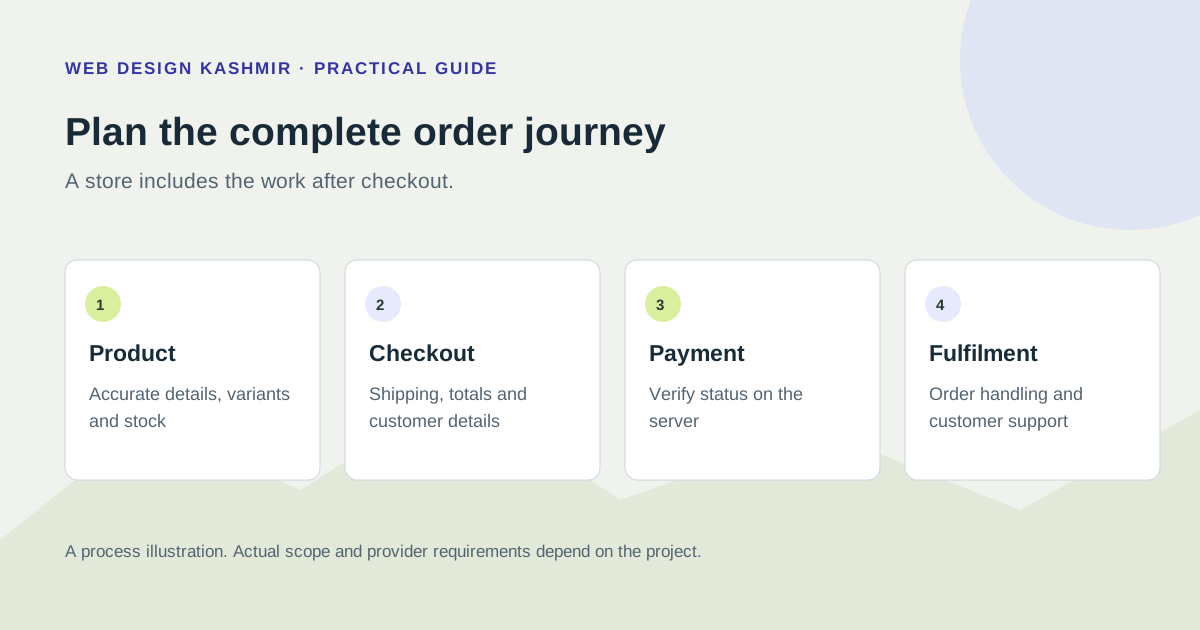
1. Create one dependable product record
Give every sellable item or variant a consistent identifier. Record its approved name, price, stock rule, weight or dimensions, photographs and relevant specifications. Decide which information belongs to the product and which belongs to a size, colour or pack option.
Use one approved source for import and future corrections. If a photograph represents a range rather than the exact item, explain that where it matters. Claims about origin, material, certification or testing need supporting evidence from the seller. A designer cannot establish product authenticity by adding a decorative badge.
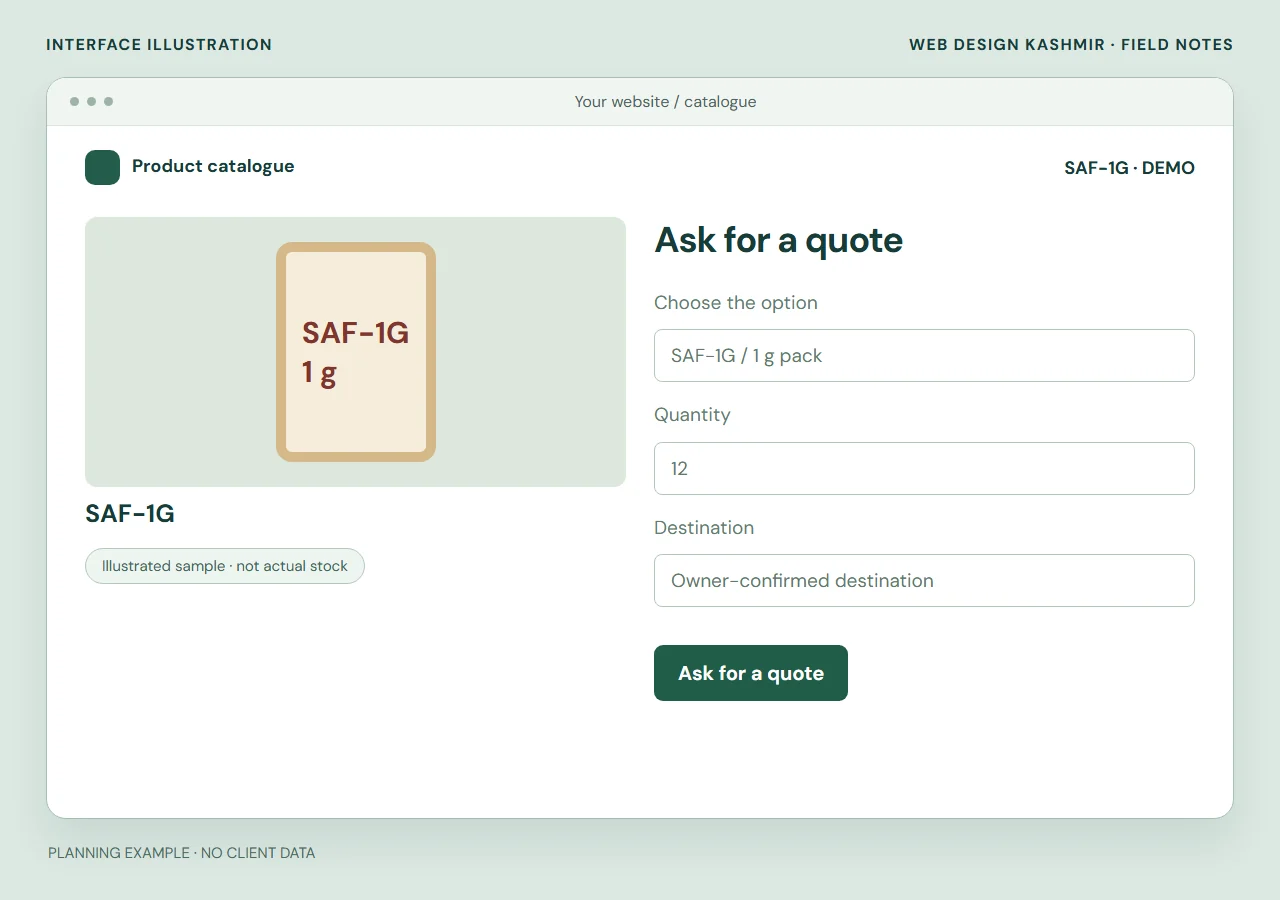
- Identify product and pack
- Keep quantity and destination
- Review order and payment state
Agree what happens when the last unit is requested twice
Use a test product with a single unit available. In two separate sessions, attempt the purchase according to the proposed stock rules. Agree when stock is held, when the hold expires and what the second customer sees.
Repeat with a failed payment, an abandoned checkout and a repeated provider notification. The expected result should state whether the order exists, whether stock remains available and whether staff receive a fulfilment instruction. A payment notification should not create a second order or ask the team to pack the same item twice.
Have the person responsible for stock approve the rule and retain the test result. If availability is still confirmed manually, a catalogue request may be the useful first release. The business can add checkout once the necessary data and operating decisions are ready.
Approve one saffron product record before importing the range
Fictional product and test specification · not inventory or a sales claim
A catalogue with three pack sizes still needs unambiguous product records. This sample establishes the identity, ordering unit and fulfilment information to preserve from the page to the staff record.
| Field | Filled example | Acceptance check |
|---|---|---|
| Identity | SAF-1G; saffron; 1 g pack. | The page, basket and order use the same code and unit. |
| Evidence | Owner-supplied photograph and approved origin/batch wording. | Do not publish a certification or provenance badge without the seller’s evidence. |
| Availability | A documented stock rule; quantities entered from the seller’s real records. | Test two sessions requesting the last unit in the agreed test environment. |
| Order state | Awaiting payment → verified payment → fulfilment review. | A failed or duplicate callback must not create a second fulfilment instruction. |
Approve this one record with the person who packs orders. A mismatch between grams, packs and cartons can become a fulfilment error even when the storefront looks polished. Keep price, delivery rules and notification wording in the same review rather than waiting for the final launch day.
The WooCommerce product-management documentation is a primary reference for its product fields. The catalogue/store decision guide helps when the seller still needs to confirm quantities or freight before accepting an order.
2. Check the economics before choosing a store platform
Selling directly can give a saffron producer or craft business more control over presentation and customer relationships. It also creates work: photography, customer support, payment charges, packaging, returns and marketing. Removing an intermediary does not make every sale pure profit.
Start with a small product set you can describe and fulfil accurately. Write the selling price, product cost, packing cost, expected shipping cost, payment charge and an allowance for returns. Work out contribution per fulfilled order before spending on ads or a large build.
Illustrative calculation, not a sales forecast: if an order sells for ₹2,000 and its product, packing, delivery and payment costs total ₹1,500, the remaining ₹500 is before marketing, returns, tax and overhead. Replace every figure with your own accounts. A higher order value does not necessarily mean a profitable store.
3. Compare Shopify, WooCommerce and custom development
| Option | Useful when | Work and costs to include |
|---|---|---|
| Shopify | You prefer a managed store product and standard commerce workflows. | Plan subscription, relevant apps, payment arrangements, themes and any third-party transaction fees. |
| WooCommerce | You want WordPress-based editing and can maintain hosting and extensions. | Hosting, backups, extensions, security updates, payment setup and operational support. |
| Custom application | A distinctive ordering or integration workflow justifies bespoke work. | Admin tools, inventory rules, security, testing, documentation and ongoing application maintenance. |
There is no universal product-count threshold that makes one platform best. Ask a staff member to add a variant, update stock, process a refund and export an order in the proposed system. These tasks reveal whether the platform fits your day-to-day work.
Provider prices and fees change. Confirm the current Shopify pricing and billing terms and equivalent quotations for other options. “Open source” or “custom” does not mean zero recurring cost. See the platform comparison checklist.
Compare the same catalog, payment, shipping, editing and integration needs across suitable platforms. Include recurring subscriptions, paid extensions, hosting where relevant and ongoing support. No platform removes the seller’s responsibility for accurate products or reliable fulfillment.
4. Decide who owns stock accuracy
If products sell in a shop and online, explain how the two channels share availability. Is stock updated manually, imported on a schedule or connected to another system? The answer determines the risk of accepting an order that cannot be fulfilled.
Check what happens with reserved stock, cancelled orders and items made to order. Avoid displaying precise availability when nobody maintains it. A quote-led catalog can be a sensible first release for variable wholesale quantities or freight, while fixed-price checkout requires dependable order rules.
5. Separate payment collection from order confirmation
Agree the payment methods the merchant account actually supports. Provider approval, business documentation and settlement arrangements belong to the merchant and provider. Do not advertise a payment option simply because a platform has an integration for it.
Review successful, failed and pending payments. A customer can close the page before returning from the payment provider, and a notification can arrive late or more than once. The store needs a consistent way to reconcile payment status with the order and give staff enough information to investigate exceptions.
6. Make shipping rules visible before payment
Confirm serviceable destinations, packing requirements, dispatch time and the delivery services available for the actual product. Separate preparation time from transit estimates. Fragile goods, perishable products and made-to-order items may need different arrangements.
Test a supported postcode and one outside the delivery area. Check mixed carts, quantity changes and any minimum order. Customers should see applicable charges and restrictions before they pay. International checkout should wait until the business has checked destination restrictions, costs and a practical returns process.
7. Define the work after an order arrives
Assign responsibility for reviewing new orders, resolving address questions, packing, dispatching and updating the customer. An alert sent to an unattended mailbox is not an operating process. Record who covers absence and how staff identify an order that needs manual attention.
Use a small set of order states that the team understands. The meanings of processing, dispatched and completed should match what actually happens. If the store uses an external fulfillment tool, define which system is authoritative and how staff handle a failed connection.
8. Prepare returns and customer communication
Have the business approve clear delivery, cancellation, return and refund information appropriate to its products and obligations. State a reachable support route and the details customers should provide. Obtain qualified advice where the applicable rules are uncertain rather than copying another shop’s policy.
Review notification text as carefully as the checkout design. A received-order message should not imply dispatch has occurred. Explain how customers report damage or a missing parcel, and keep necessary records without collecting unrelated personal information.
9. A worked launch example for a saffron catalogue
This is an illustrative specification, not a client revenue case study. Consider a business starting with three pack sizes of one saffron product. The product record might include a SKU, pack weight, current price, available stock, batch reference, photographs and a dispatch estimate.
The customer chooses a pack, sees the complete charge and reads the shipping and return terms before payment. After payment verification, the order enters a staff queue. Staff confirm stock, pack the correct item, attach tracking and handle any exception without editing the payment history manually.
Acceptance test: buy the final available pack from two browser sessions. The store should apply its documented stock-reservation rule and avoid selling stock it cannot supply. Test a failed payment followed by a successful retry, then verify that only the completed order reaches fulfilment.
10. Run a small end-to-end rehearsal
Before opening the store, complete test journeys that include a successful order, payment failure, unavailable item, unsupported destination and cancellation. Verify the customer messages, staff notifications, stock behavior and the record used for reconciliation.
Then ask a person unfamiliar with the site to locate a product and explain the delivery and return conditions. Resolve confusing information before increasing promotion. Launch with a catalog the team can maintain, document outstanding limitations and review real order problems. Development supports the sales process; it does not guarantee demand, revenue or profit.