
Choose the sales process before the platform
A catalogue explains what you supply and helps a buyer ask an informed question. A quote basket lets the buyer collect several items and quantities into one request. An online store accepts an order under defined prices, payment and fulfilment rules. Those are different commitments, even when all three use similar product cards.
For a Bahrain distributor selling made-to-order items or variable delivery quantities, the quote route can be a sensible first release. For standard products with reliable stock, agreed shipping and supported payments, checkout may remove unnecessary correspondence. A mixed range can use both, provided every product clearly states which action is available.
| Your situation | Useful starting route | Confirm before launch |
|---|---|---|
| Prices or delivery depend on quantity, specification or destination. | Catalogue with a specific enquiry. | Who checks the request and prepares the quotation? |
| Buyers normally ask about several product codes together. | Catalogue with a quote basket. | Does one request preserve each code, unit and quantity? |
| Price, stock, delivery and payment can be confirmed automatically. | Online store. | Can you complete and reverse a test order using the provider’s test facilities? |
| Some products are standard; others require discussion. | Explicit purchase or enquiry routes by product. | Can a buyer tell what happens next without reading a general FAQ? |
The WooCommerce catalogue-visibility documentation describes controls for disabling purchases or showing prices to selected users. A platform can support catalogue behaviour, but changing the button wording alone does not establish the business workflow. Agree the actual cart, checkout and notification behaviour as part of the scope.
See what a useful quote request contains
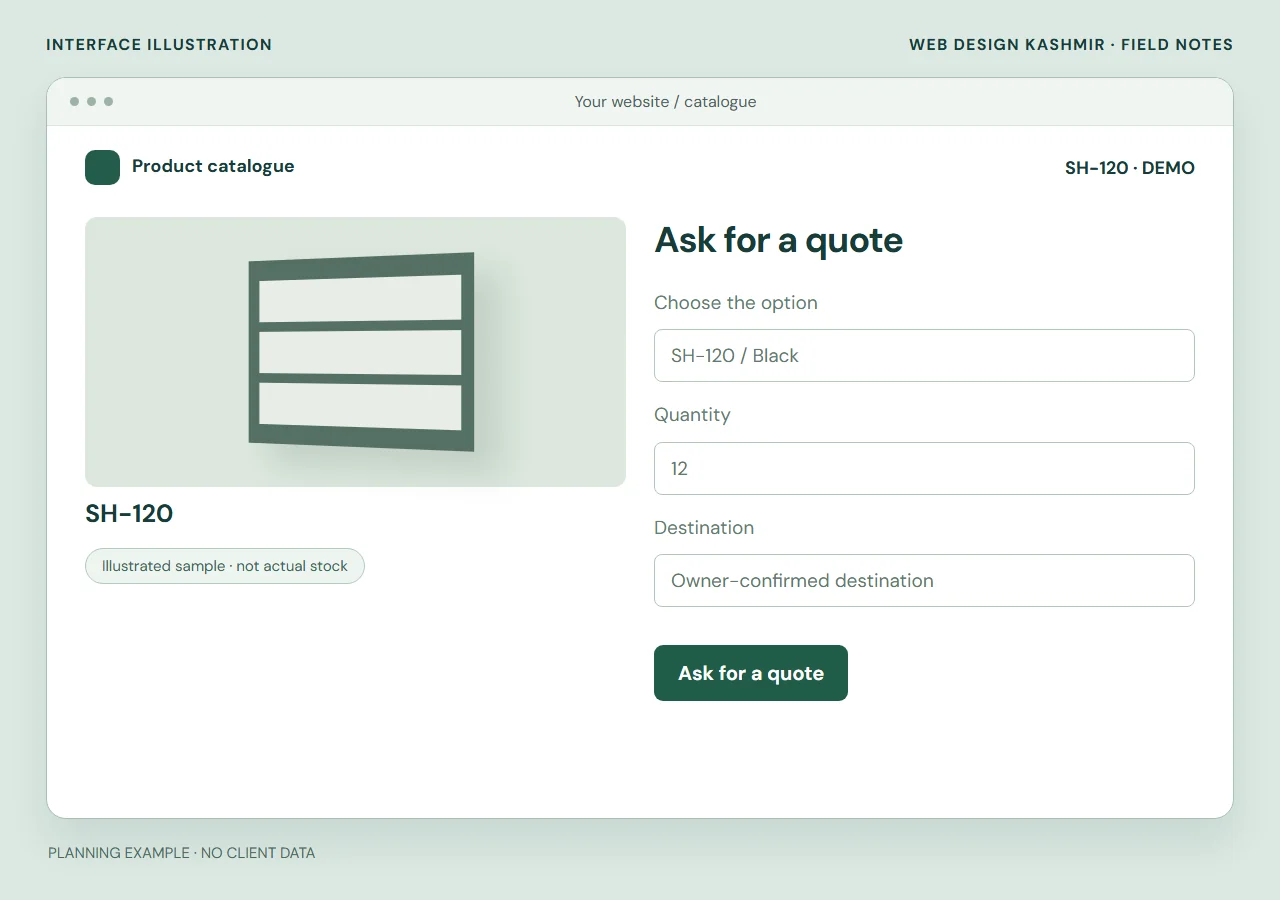
Consider a fictional shelving supplier with 48 product records in eight categories. Its customers often need a mixed order and a delivery estimate. The first release does not need account-specific price lists or an enterprise resource planning integration merely to collect a useful request.
Worked example · invented for planning
Request: 12 shelving sets for Manama
- Product
- SH-120 shelving set · black finish
- Quantity and unit
- 12 sets, rather than an ambiguous “12”
- Delivery requirement
- Manama delivery; buyer asks the supplier to confirm timing
- Sales-team decision
- Confirm stock, specification, delivery and final quotation
- Customer confirmation
- “Request received. This is not an accepted order.”
The product code and finish should travel with the enquiry. A WhatsApp message that only says “I am interested” makes the sales team rediscover the product. A protected email form provides an alternative when WhatsApp is unavailable or the buyer prefers a business email record. Do not require a mobile number just to ask a product question if an email reply will do.
For a quote basket, define whether quantities survive a page reload and how an unavailable item is handled. Tell the buyer if their selection is stored only on that device. Keep the confirmation separate from a quotation: receiving a message does not confirm a price, reserve stock or create a paid order.
Prepare one complete product record
Before importing the entire range, approve one representative product page. It should contain enough accurate information for a buyer to distinguish the item from a similar model. Use your own product photographs or images you are licensed to publish. Generated product pictures should not imply an exact finish, accessory or specification that the real item does not have.
| Field | What to supply | Why it matters |
|---|---|---|
| Identity | Unique code, public name, category and status. | The website and quotation refer to the same item. |
| Options | Available sizes, colours, finishes and their codes. | A buyer does not accidentally request an unavailable combination. |
| Ordering unit | Each, box, set, metre or another explicit unit; minimum quantity if relevant. | The requested quantity has a shared meaning. |
| Evidence | Actual photographs, approved dimensions and current specification files. | The visitor can check the details without guessing from a decorative image. |
| Commercial wording | Price visibility, delivery limits and what requires confirmation. | The page does not promise an unapproved sale. |
| Ownership | Person responsible for changes and the review date. | Discontinued products and outdated files can be corrected. |
Keep a stable product URL when a photograph or description changes. If a product is withdrawn, decide whether the page should explain a replacement, remain as reference or be removed. Redirect only where the destination is a meaningful substitute. Avoid directing every retired model to the homepage.
Plan language, navigation and search
Choose English, Arabic or both from the customers you actually serve. For a bilingual catalogue, translate the category names, ordering units, enquiry labels, errors and confirmation messages as well as the sales copy. Product codes may remain in Latin characters, so check them within right-to-left text. A competent reviewer should approve the business terminology.
Give useful product groups their own descriptive category pages. A category such as “commercial shelving” can explain the range and selection criteria; it should not be a repeated paragraph attached to dozens of filter combinations. Choose which filter pages are valuable enough to be independent search destinations, then control the remaining URL combinations deliberately.
Google’s multiregional and multilingual guidance explains separate language URLs and regional signals. Adding Bahrain repeatedly to otherwise identical pages does not create a useful catalogue. The product information, delivery coverage and language support must match the real business.
For an inspectable interface example, open Ratib Calculator, an independent project I own and develop. It shows Arabic labels and numeric inputs together. It is not a Bahrain catalogue client or evidence of sales results; the relevant question is how clearly mixed-language information is presented.
Compare proposals using the same scope
A quote for “an ecommerce website” is difficult to compare with a quote for 48 approved product records, eight category pages, two languages and one enquiry workflow. Ask each supplier to identify what is included in data entry, image preparation, translation, licence renewals, payment integration and handover. Separate one-time build work from recurring hosting, support and external platform fees.
For a Bahrain project, agree the quotation currency, payment milestones and responsibility for any applicable taxes in the proposal. Your business and its adviser should approve its commercial and tax wording. A website developer should not invent these terms from a generic template. Request approval before adding a paid extension or third-party subscription.
Test the customer and sales-team journeys
- Open a category on a phone and find a named product without horizontal scrolling.
- Read the code, unit, image description and relevant specification without relying on colour alone.
- Request two different products and verify that both codes, options and quantities reach the agreed recipient.
- Try the protected form with an omitted field, an expired session and a valid test request in staging. Agree who receives test notifications before running it.
- Check the WhatsApp destination and prefilled message without sending an unsolicited live message.
- Ask the business owner to change one product and remove a discontinued item using the handover notes.
Clear, persistent form labels are part of this acceptance work. The W3C form-label tutorial explains the relationship between labels and controls. An attractive placeholder that disappears while typing should not be the only explanation of a field.
Copy this first-release brief
My business sells: ___
Launch range: ___ products / ___ categories
Before accepting an order we must confirm: ___
Website route: catalogue enquiry / quote basket / online checkout / mixed
Languages and approved reviewer: ___
Product photos and data owner: ___
Enquiries go to, with a backup recipient: ___
Required integration and account owner: ___
First-release acceptance checks: ___
For remote delivery from Srinagar, India, read the Bahrain catalogue website service and the ecommerce development scope. Send your current website and one representative product record. We can then decide whether a catalogue, quote basket or store fits the first release.
- Product and option
- Quantity and destination
- Review and confirm
Check three failure cases in a request for quotation
Fictional Bahrain shelving supplier · functional specification
The shelving example above defines a normal request. A request for quotation (RFQ) also needs to preserve changes and explain its status. Use these fictional cases when reviewing the preview with the sales recipient.
| Test case | Sample input | Expected result to agree |
|---|---|---|
| An option changes | The buyer selects a different finish for SH-120. | The final request contains the chosen finish once, without silently keeping an earlier option. |
| Quantity is edited | Change 2 sets to 12 sets before submitting. | The request summary and received message both state 12 sets; the unit remains explicit. |
| The page is reloaded | Prepare a multi-product request, then reload. | The site follows its documented storage rule and tells the buyer if the selection is lost. |
| A message is acknowledged | Submit the agreed staging request. | Receipt does not claim that stock is reserved or a final quotation accepted. |
Record the input, the expected message and the observed result for each case. A photograph of a product cannot show whether its code and selected option reach the recipient. The acceptance record should make that connection visible, without publishing the recipient’s private contact details.
These are proposed checks, not claims about a completed shop. Define quote-basket storage, sales review and order acceptance in the Bahrain catalogue scope before adding checkout or other store functions.
Questions before you start
Can I launch a catalogue now and add online checkout later?
Yes, if the first release uses stable product codes, suitable data and a structure that can support the later workflow. Adding checkout still requires its own stock, pricing, payment, delivery and acceptance checks.
Does every catalogue need customer accounts?
No. Public product pages and a clear enquiry route may be enough. Accounts are useful when they serve an agreed need such as restricted ranges, customer-specific information or repeat ordering.
Should an enquiry button say Buy now?
Use wording that matches the action. Request a quote or Ask about this product is clearer when your team must confirm the price, stock or delivery before accepting an order.
Sources and editorial notes
Published 18 October 2026. The worked examples are fictional planning scenarios. Confirm integration features, account eligibility and current terms with your chosen provider before agreeing the build.