Evidence at a glance
What this review records
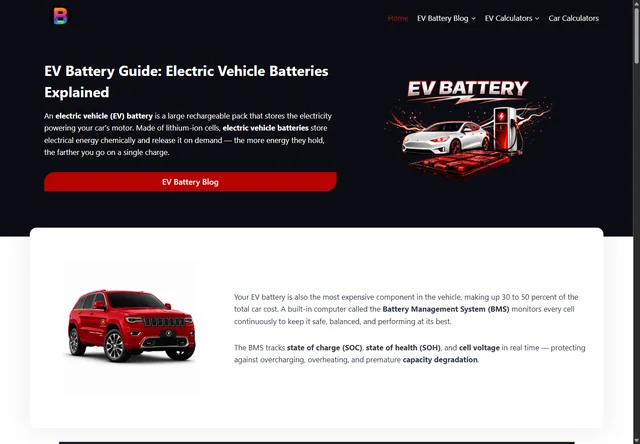
The reviewed homepage separates battery basics, chemistry, charging and other topics. Its home-charging-cost calculator link reaches a page that returns HTTP 200 and declares explicit units and input ranges in the public HTML.
- Owner & developer
- Muzamil Ahad
- Project relationship
- Independently owned project
- Focus
- Content structure · topic navigation · labelled inputs
The editorial navigation problem
EV Battery Guide is an independently owned reference website. Its homepage introduces the battery topic, then provides routes into more specific subject groups and tools. Muzamil Ahad is the website owner and developer; subject-matter authorship is identified separately on the project.
A first-time reader may want an explanation of battery construction. Someone already comparing charging options may need a calculator or a narrower guide. The navigation has to make those paths understandable without assuming that every visitor will read the entire homepage first.
This review examines the public structure returned on 18 October 2026. It does not claim an undocumented redesign, before-and-after result or search-performance gain. The linked project remains inspectable so a prospective customer can compare the notes with its current presentation.
A dated public-page review
| Observed item | Concrete evidence | Why it matters to the interface |
|---|---|---|
| Homepage response. | The requested homepage returns HTTP 200 with the H1 “EV Battery Guide: Electric Vehicle Batteries Explained.” | The page identifies its broad subject before offering more specific reading paths. |
| Section structure. | Headings include how a battery works, what it is made of, lifespan, replacement cost, charging, safety, end of life and battery-type choice. | Descriptive sections provide an outline of the subject instead of a single undifferentiated introduction. |
| Topic navigation. | Category links include Battery Basics, Chemistry, Brand Specific Batteries, EV Charging, BMS and recycling. | Readers can leave the broad page for the kind of question they came to answer. |
| Linked tool route. | The homepage links to /home-charging-cost-calculator/. A direct request to that exact page returns HTTP 200. | The tool has a dedicated destination that can explain its assumptions beside its inputs. |
The homepage includes a named subject-author byline. This note does not independently verify the credentials or every scientific, price, warranty or safety statement published on the project. A well-organised interface and an accurate technical article are related responsibilities, but one does not prove the other.
The calculator’s input contract
The reviewed home-charging-cost page declares labelled inputs for battery capacity, vehicle efficiency and electricity rate. Its HTML uses number fields and range controls, keeping capacity, distance, price and percentage settings separate rather than hiding them inside one unexplained preset.
The captured defaults include battery capacity 70, efficiency 3.4 and a flat electricity rate of 0.17. They are interface defaults, not measured specifications for a visitor’s car or a claim about the current price of electricity. Daily mileage, days per week, the share charged at home and charging efficiency are also individual inputs in the returned page.
The capacity field declares a 10–250 range with a 0.5 step, and the efficiency field declares a 1–7 range with a 0.1 step. The flat-rate field declares a non-negative range up to 1.5. Those HTML constraints describe the public input contract. This review did not exercise out-of-range values, inspect all calculation code or certify the numerical output, so their presence is not presented as proof of complete validation.
Make the reading routes understandable
- Start broad, then offer a choice. The explanatory homepage supports a new reader, while named category links offer a shorter route for a specific interest.
- Separate explanation and estimation. A charging-cost calculator should disclose its inputs and units instead of presenting one cost as universally applicable.
- Keep responsibility visible. The site-development role can be described without borrowing a subject author’s expertise or claiming engineering qualifications.
- Use images to support the topic. Diagrams and contextual media should remain connected to explanatory text and an identified source, rather than being treated as proof of a numerical claim.
For a similar editorial project, approve the topic taxonomy, one complete article and one tool specification before creating a large page count. A useful preview lets the editor check a real reading journey: broad question, narrower explanation, relevant tool and a clear way back to supporting content.
Development evidence and subject expertise
The reviewed public pages are the evidence for this note. No private content-management system, server configuration, analytics account, author record or database was accessed. Public asset paths alone do not establish the complete hosting architecture or prove who performed a historical implementation task.
A fuller acceptance review would test calculator outputs against an approved specification, inspect error states and keyboard operation, check relevant links and review article claims with an appropriate subject specialist. It would also record how editors update content and who owns the published sources. None of those outcomes is inferred from an attractive homepage or a successful HTTP response.
The related WordPress development scope and business website scope explain how editable content, navigation and handover can be agreed for a new project. The platform and support arrangement should follow the actual publishing workflow.
Evidence links and review date
Published 19 October 2026. Public responses, interface observations and served files were reviewed on 18 October 2026. Linked websites and scripts can change after that date. This is a current implementation review, with test limits recorded alongside the observations.
- Working editorial homepage ↗
- Public home-charging-cost calculator ↗
- Battery basics category linked from homepage ↗
- EV charging category linked from homepage ↗
Suggest a correction with the page URL and supporting evidence.
Plan your own project
Bring the task, not just a reference image.
Share your public website, the action visitors need to complete and the content you can supply. We can agree the inputs, pages, integrations and acceptance checks before estimating the work.
Talk through your website on WhatsApp ↗