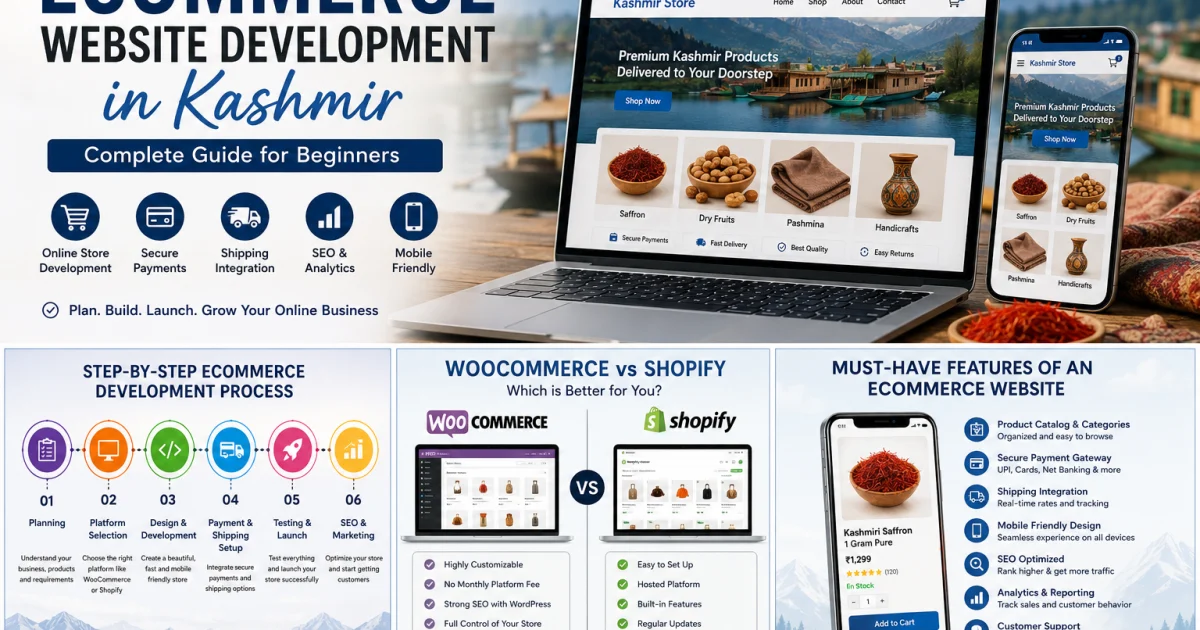
Ecommerce Website Development in Kashmir: Complete Guide
Many Kashmir businesses have good products but still depend only on walk-in customers, Instagram messages, WhatsApp orders, or middlemen. That works in the beginning, but it becomes hard when orders grow, customers ask the same questions again and again, and payments or shipping become confusing.
This is where ecommerce website development in Kashmir becomes useful.
A proper online store helps you show products, accept payments, manage orders, track inventory, and reach customers outside your local market. Whether you sell saffron, dry fruits, pashmina, clothing, bakery items, handicrafts, cosmetics, electronics, or local services, an ecommerce website can make your business easier to run.
This article explains everything in simple English: what an ecommerce website needs, how much it may cost, which platform to choose, how payment and shipping work, what mistakes to avoid, and how Web Design Kashmir can help you build a store that is ready for real customers.
Quick Answer:
Ecommerce website development in Kashmir means building an online store where customers can view products, add them to cart, pay online, and place orders from mobile or desktop. A good ecommerce website should include product pages, secure checkout, UPI/card payment options, shipping setup, mobile-friendly design, inventory control, analytics, and SEO. For many Kashmir businesses, WooCommerce is a good choice because it works well with WordPress and Indian payment gateways. Shopify is also useful for sellers who want a hosted platform with less technical maintenance.
Key Takeaways
- A normal business website is not the same as an ecommerce website. An ecommerce website needs cart, checkout, payment, product management, shipping, and order tracking.
- For most small and medium businesses in Kashmir, WooCommerce is a practical option because it gives more control and works well for local SEO.
- Shopify is easier to manage for some businesses, but it has monthly fees and many paid apps.
- Your store should be built for mobile first because many buyers will visit from phones, not laptops.
- Product photos, product descriptions, trust badges, return policy, and delivery details can directly affect sales.
- Do not build only a “beautiful” website. Build a store that loads fast, accepts payments smoothly, and helps customers finish their order.
- A Kashmir ecommerce store should plan local and national shipping before launch, especially for saffron, dry fruits, clothing, handmade items, and fragile products.
What Is Ecommerce Website Development?
Ecommerce website development is the process of creating a website where people can buy products or services online.
It is different from a simple business website. A simple website tells people about your business. An ecommerce website lets people take action: choose a product, add it to cart, pay online, and place an order.
A complete ecommerce website usually includes:
- Homepage
- Product category pages
- Product detail pages
- Cart page
- Checkout page
- Payment gateway
- Shipping setup
- Order management
- Inventory dashboard
- Customer account area
- Email or WhatsApp order alerts
- SEO setup
- Analytics tracking
For example, a dry fruit seller in Srinagar may need categories like almonds, walnuts, saffron, honey, and gift boxes. A clothing store in Baramulla may need size options, color options, stock alerts, discount codes, and delivery charges.
The goal is not only to “make a website.” The goal is to build a selling system.
For local businesses, Web Design Kashmir offers dedicated ecommerce website development in Kashmir with store design, payment setup, shipping setup, mobile checkout, and SEO-friendly product pages.
Why Kashmir Businesses Need Ecommerce Websites
Kashmir has many products that people outside the region already know and trust. Saffron, pashmina, dry fruits, carpets, paper mache, walnut wood items, handmade clothing, and local food products all have demand beyond one local shop.
But many sellers still depend on offline buyers, resellers, or social media messages.
That creates problems:
- Orders are hard to track.
- Customers keep asking for price and product photos.
- Payments are manual.
- There is no proper product catalog.
- Out-of-stock products still get promoted.
- New customers do not fully trust the seller.
- Google cannot rank Instagram or WhatsApp chats like a proper website.
An ecommerce website solves many of these issues.
It gives your business a permanent online store that customers can visit any time. It also helps you look more professional when someone searches your brand name on Google.
A good online store can help:
- Retail shops sell beyond their local area.
- Artisans reach buyers directly.
- Food brands manage prepaid orders.
- Clothing stores display sizes and collections.
- Gift businesses sell seasonal boxes.
- Service businesses accept bookings or advance payments.
Your website becomes your digital shop, product catalog, payment counter, and order desk in one place.
What Features Should an Ecommerce Website Have?
A beginner may think ecommerce means only “add products and payment.” In reality, a good ecommerce website needs many small parts working together.
1. Mobile-Friendly Store Design
Most customers will open your store on a mobile phone. Your website should look clean on small screens, buttons should be easy to tap, and checkout should not feel confusing.
Important mobile features include:
- Clear menu
- Fast-loading product images
- Sticky cart button
- Simple product filters
- Easy quantity selector
- Short checkout form
- WhatsApp support button
A mobile-first store is not optional anymore. It is the basic standard.
2. Product Catalog and Categories
Your products should be arranged in a way that customers understand quickly.
Example for a saffron and dry fruit store:
- Kashmiri Saffron
- Walnuts
- Almonds
- Dried Fruits
- Honey
- Gift Packs
Example for a clothing store:
- Men
- Women
- Kids
- Winter Wear
- New Arrivals
- Sale
Good categories help customers find products faster. They also help Google understand your website.
3. Product Pages That Build Trust
A product page should do more than show one photo and a price.
A strong product page includes:
- Product name
- Clear price
- Multiple photos
- Short description
- Full details
- Size, weight, color, or quantity options
- Delivery information
- Return or exchange policy
- Stock status
- Customer support option
- FAQs if needed
For Kashmiri products, product pages should explain authenticity. For example, saffron pages can mention grade, origin, packaging, usage, and storage. Pashmina pages can explain material, care, size, and work type.
4. Secure Payment Gateway
An ecommerce website should allow customers to pay safely.
Common payment options in India include:
- UPI
- Debit card
- Credit card
- Net banking
- Wallets
- EMI, if supported
- Cash on delivery, if suitable
Razorpay, PayU, Instamojo, and CCAvenue are common options for Indian ecommerce stores. The right choice depends on your business type, documents, bank account, and required payment methods.
5. Shipping and Order Tracking
Shipping is one of the most important parts of ecommerce.
A Kashmir business should decide:
- Do you deliver only in Kashmir?
- Do you ship across India?
- Do you ship outside India?
- What will be your delivery charge?
- Will you offer free shipping above a certain amount?
- Which products need special packaging?
- How will customers track orders?
Shipping tools like Shiprocket, Delhivery, and India Post can help manage courier bookings and tracking. For fragile or premium products, packaging must be planned before launch.
6. Inventory Management
Inventory management helps you avoid selling products that are not available.
Your store should allow you to:
- Add stock quantity
- Mark products as out of stock
- Get low-stock alerts
- Manage product variations
- Track orders from one dashboard
This is useful for clothing sizes, limited handmade items, seasonal products, and gift boxes.
7. SEO Setup
If you want your ecommerce website to get organic traffic from Google, SEO should be planned from the start.
Basic ecommerce SEO includes:
- Clean product URLs
- Meta titles
- Meta descriptions
- Image alt text
- Product schema
- Category descriptions
- Fast loading speed
- Internal linking
- Google Search Console setup
- XML sitemap
For help with ranking, you can connect your online store with SEO services in Kashmir so product pages and category pages are not built blindly.
WooCommerce vs Shopify for Kashmir Businesses
Both WooCommerce and Shopify can work for ecommerce. The right choice depends on your budget, control, product type, and long-term plan.
| Feature | WooCommerce | Shopify |
|---|---|---|
| Best for | Businesses that want control and SEO flexibility | Businesses that want easier hosted setup |
| Monthly platform fee | No fixed WooCommerce platform fee, but hosting and plugins may cost | Monthly Shopify plan required |
| Website control | High control | Limited compared to custom WordPress setup |
| SEO flexibility | Strong, especially with WordPress | Good, but some limits |
| Indian payment gateways | Good support | Good support |
| Maintenance | Needs updates and care | Platform handles many technical parts |
| Custom design | Very flexible | Flexible, but theme/app limits apply |
| Best Kashmir use case | Saffron, dry fruits, handicrafts, clothing, local brands | D2C brands that want quick setup and easy management |
Which One Should You Choose?
Choose WooCommerce if you want:
- More control
- Strong SEO options
- Lower platform dependency
- Custom design
- WordPress blog integration
- Local service pages and product pages together
Choose Shopify if you want:
- Hosted platform
- Easier backend
- Less technical setup
- Faster basic launch
- Built-in app system
For most local businesses in Kashmir, WooCommerce is often a strong starting point. It works well for businesses that want ecommerce, blogging, service pages, and SEO in one website.
Web Design Kashmir can help you decide during the planning stage. You can also check website pricing in Kashmir to understand which package fits your business.
Ecommerce Website Cost in Kashmir
The cost of an ecommerce website in Kashmir depends on the number of products, design quality, payment setup, shipping needs, platform, content, SEO, and custom features.
A basic ecommerce website will cost less than a custom store with advanced filters, customer dashboards, multiple payment methods, coupons, shipping rules, and SEO pages.
Here is a simple cost breakdown:
| Store Type | Best For | Common Features | Estimated Budget Level |
| Basic Ecommerce Store | Small shops starting online | Product pages, cart, checkout, payment gateway, basic SEO | Entry-level |
| Professional Ecommerce Store | Growing businesses | Custom design, product categories, payment, shipping, analytics, SEO setup | Mid-level |
| Advanced Ecommerce Store | Serious brands | Custom UI, advanced filters, automation, email setup, SEO strategy, tracking | Higher-level |
| Custom Ecommerce System | Unique business models | Custom dashboard, special workflows, app/API integrations | Custom quote |
The biggest cost factors are:
- Number of products
- Number of categories
- Custom design requirements
- Product photography support
- Payment gateway setup
- Shipping integration
- SEO pages and content
- Multi-language needs
- Coupon and offer system
- Custom dashboard features
- Maintenance and security
Do not choose only the cheapest option. A weak ecommerce website can lose customers at checkout, load slowly on mobile, or fail to rank on Google.
A better question is: “Will this website help customers buy easily?”
Step-by-Step Ecommerce Website Development Process
A proper ecommerce project should follow a clear process. This prevents confusion and saves time.
Step 1: Business and Product Planning
Before design starts, list what you sell.
Write down:
- Product categories
- Product names
- Prices
- Stock quantity
- Delivery areas
- Return rules
- Payment options
- Product photos needed
- Offers or bundles
Example: A dry fruit business may create gift packs for Eid, wedding season, and corporate orders. A clothing store may create size charts before products are uploaded.
Step 2: Platform Selection
Choose WooCommerce, Shopify, or custom development based on your needs.
A small business should not start with unnecessary custom software. Start with a system that is reliable, easy to manage, and suitable for your budget.
Step 3: Website Structure
Plan the main pages:
- Home
- Shop
- Category pages
- Product pages
- About
- Contact
- Shipping Policy
- Return Policy
- Privacy Policy
- Terms and Conditions
- FAQs
Local stores should also include trust pages. For example, an About page can show your story, location, business background, and customer support details.
You can review custom website design in Kashmir if your ecommerce project also needs a strong brand website, not only a shop page.
Step 4: Design and Development
The design should match your product.
A pashmina store needs a premium look. A bakery store needs warm food visuals. A tech store needs a clean and fast product layout. A local clothing brand needs strong mobile browsing and filters.
Development should include clean code, fast loading, secure checkout, and easy backend management.
Step 5: Product Upload
Each product should have:
- Clean title
- High-quality image
- Price
- Short description
- Long description
- SKU if needed
- Stock status
- Category
- Tags
- Weight or size
- SEO title
- SEO description
- Alt text
Poor product upload is one of the biggest reasons ecommerce stores fail. If the photos are weak and descriptions are unclear, customers hesitate.
Step 6: Payment and Shipping Testing
Before launch, test:
- UPI payment
- Card payment
- Failed payment handling
- Order confirmation email
- Admin order alert
- Shipping charges
- Coupon codes
- Mobile checkout
- Invoice generation
- Refund process if needed
Never launch without testing checkout on mobile.
Step 7: SEO and Analytics Setup
Your store should be connected to:
- Google Search Console
- Google Analytics 4
- XML sitemap
- Product schema
- Basic conversion tracking
- Meta tags
- Image SEO
This helps you understand what people search, what products they view, and where they drop off.
Step 8: Launch and Improve
Launch is only the beginning.
After launch, check:
- Which products get views
- Which products get add-to-cart clicks
- Which pages are slow
- Which keywords bring traffic
- Which products need better photos
- Which checkout step causes drop-offs
Ecommerce improves through small changes every month.
Ecommerce SEO for Kashmir Online Stores
A store without SEO depends only on paid ads, social media, or repeat buyers. That is risky.
Ecommerce SEO helps your product and category pages appear when people search on Google.
Example keywords:
- buy Kashmiri saffron online
- Kashmiri dry fruits online
- pashmina shawl online
- handmade paper mache Kashmir
- walnut wood products Kashmir
- clothing store in Srinagar
- gift boxes Kashmir
Important Ecommerce SEO Areas
Product page SEO:
Each product needs a clear title, helpful description, original photos, price, stock status, and product schema.
Category page SEO:
Category pages should include useful text. For example, a “Kashmiri Saffron” category page should explain types, origin, packaging, and buying tips.
Image SEO:
Images should have descriptive file names and alt text. Use “kashmiri-saffron-1g-pack.jpg” instead of “IMG_2345.jpg.”
Internal linking:
Link related products, categories, buying guides, and service pages. For example, a blog about choosing saffron can link to saffron products.
Technical SEO:
Your site should load fast, work on mobile, use HTTPS, have clean URLs, and include a sitemap.
For location-based visibility, businesses in Srinagar can also connect ecommerce pages with web design company in Srinagar, while North Kashmir businesses can use web design in Baramulla as a local support page.
Common Mistakes Beginners Make
1. Starting Without Product Planning
Many businesses ask for a website before preparing product names, prices, photos, and delivery rules.
Fix it by making a simple product sheet first. Add product name, price, stock, category, weight, and short description.
2. Using Low-Quality Product Photos
Customers cannot touch the product online. Photos must do the selling.
Fix it by using clear images from different angles. For premium products, use a clean background and natural light.
3. Making Checkout Too Long
A long checkout form can make customers leave.
Fix it by asking only for needed details: name, phone, address, email, and payment method. Keep buttons clear.
4. Ignoring Shipping Before Launch
Many stores launch first and think about shipping later. This creates confusion when real orders arrive.
Fix it by deciding courier partners, charges, packaging, and delivery areas before launch.
5. Copying Product Descriptions
Copied descriptions make your store look weak and may not help SEO.
Fix it by writing original descriptions in simple language. Explain what the product is, who it is for, size, material, usage, and care.
6. Not Adding Trust Pages
Customers need to know who they are buying from.
Fix it by adding About, Contact, Return Policy, Shipping Policy, Privacy Policy, and Terms pages.
7. Forgetting Maintenance
An ecommerce website needs updates, backups, security checks, and product changes.
Fix it by planning monthly maintenance. This is important for WooCommerce stores, plugins, payment systems, and security.
Practical Ecommerce Website Checklist
Use this checklist before starting your ecommerce website:
- Product list prepared
- Product prices finalized
- Product photos ready
- Product categories planned
- Business name and logo ready
- Domain name selected
- Hosting selected
- Payment gateway documents ready
- Bank account ready
- Shipping method selected
- Return policy written
- Privacy policy written
- Terms and conditions written
- WhatsApp support number ready
- Product descriptions written
- SEO keywords selected
- Google Search Console planned
- Analytics tracking planned
- Launch offer planned
- Maintenance plan ready
Why Choose Web Design Kashmir for Ecommerce Website Development?
Choosing a local team matters when your business is based in Kashmir.
A local ecommerce developer understands:
- Kashmir product categories
- Local customer behavior
- Seasonal selling patterns
- Courier challenges
- Local business budgets
- Mobile-first browsing
- Hindi, Urdu, Kashmiri, and English communication needs
- Local SEO for Srinagar, Baramulla, Jammu, Sopore, and nearby areas
Web Design Kashmir builds ecommerce websites for businesses that want more than a basic template. The focus is on fast loading, mobile design, secure checkout, product SEO, payment setup, shipping support, and easy store management.
The team can help with:
- WooCommerce ecommerce websites
- Shopify store setup
- Product catalog structure
- Payment gateway integration
- Shipping setup
- Mobile checkout design
- Product SEO
- Google Analytics setup
- Search Console setup
- Ongoing website maintenance
Businesses outside Srinagar can also get support. You can explore web design in Jammu or reach the team directly through contact Web Design Kashmir.
Your Next Step
An ecommerce website is not just a design project. It is a sales system for your business.
The three most important things are simple: make products easy to understand, make checkout easy to finish, and make your store trustworthy. Once these are done, SEO, content, ads, and social media can bring more people to the store.
Your next step is simple. Take 10 minutes and write a list of your top 20 products, their prices, and where you want to deliver. That list will make your ecommerce website planning much easier.
Build the store properly once, and it can work for your business every day.
FAQ SECTION
Q1. What is ecommerce website development in Kashmir?
Ecommerce website development in Kashmir means creating an online store for a Kashmir-based business. The store can show products, accept payments, manage orders, track stock, and help customers buy from mobile or desktop. It usually includes product pages, cart, checkout, payment gateway, shipping setup, order emails, admin dashboard, SEO setup, and analytics. It is useful for businesses selling saffron, dry fruits, clothing, handicrafts, bakery items, cosmetics, electronics, or other products.
Q2. How much does an ecommerce website cost in Kashmir?
The cost depends on product count, platform, design, payment setup, shipping needs, SEO, and custom features. A basic store costs less than a custom ecommerce website with advanced filters, automation, multiple payment methods, and detailed SEO. For a serious business, price should not be judged only by page count. The real value is in smooth checkout, secure payment, fast speed, mobile experience, product management, and support after launch.
Q3. Which is better for Kashmir businesses: WooCommerce or Shopify?
WooCommerce is often better for businesses that want control, strong SEO, WordPress content, and flexible design. Shopify is better for businesses that want a hosted platform and simpler backend management. For many small and medium businesses in Kashmir, WooCommerce is a good starting point because it works well with Indian payment gateways and local SEO pages. Shopify can be useful for brands that want quick setup and fewer technical tasks.
Q4. Can I accept UPI payments on my ecommerce website?
Yes, an ecommerce website can accept UPI payments through payment gateways such as Razorpay, PayU, Instamojo, or CCAvenue. These gateways can also support debit cards, credit cards, net banking, wallets, and other payment options depending on approval and setup. You will usually need business documents, bank details, PAN, and KYC information. The exact requirements depend on the payment gateway and your business type.
Q5. Do I need GST for an ecommerce website in Kashmir?
GST requirements depend on your business model, product type, turnover, state rules, and whether you sell through your own website or marketplaces. Some payment gateways and logistics partners may also ask for business documents during onboarding. It is better to speak with a local accountant before launching. Your website developer can build the ecommerce store, but tax registration and compliance should be checked with a qualified professional.
Q6. Can I sell Kashmiri products outside Kashmir through my website?
Yes, you can sell outside Kashmir if your website has payment, shipping, packaging, and order tracking properly set up. Products like saffron, dry fruits, pashmina, handicrafts, and gift boxes can be sold across India if packaging and courier rules are handled correctly. For fragile, premium, or perishable products, test packaging before taking large orders. Also add clear delivery timelines, return rules, and customer support details.
Q7. How long does it take to build an ecommerce website? — Source: People Also Ask
A small ecommerce website can often be completed in a few weeks if product details, photos, content, policies, and payment documents are ready. A larger store with custom design, many products, advanced filters, shipping rules, and SEO pages can take longer. Delays usually happen when product photos, pricing, categories, or policies are not ready. Planning before development is the fastest way to launch on time.
Q8. Is Instagram enough, or do I need an ecommerce website?
Instagram is useful for attention, but it is not a full ecommerce system. Customers still need to message you for prices, payment, delivery, and order status. A website gives you product pages, cart, checkout, payment, tracking, SEO, and trust pages. The best approach is to use both. Instagram can bring visitors, and your ecommerce website can convert them into customers with a proper buying process.
Q9. What pages are needed for an ecommerce website?
An ecommerce website should have a homepage, shop page, category pages, product pages, cart, checkout, account page, about page, contact page, shipping policy, return policy, privacy policy, terms and conditions, and FAQs. For SEO, it should also have helpful category content and blog posts. For trust, add phone number, WhatsApp support, location, payment details, and clear business information.
Q10. Can Web Design Kashmir build ecommerce websites for Srinagar, Baramulla, and Jammu businesses?
Yes. Web Design Kashmir works with businesses across Srinagar, Baramulla, Jammu, and other parts of Jammu & Kashmir. The team can build ecommerce websites for local retailers, clothing stores, dry fruit sellers, saffron brands, handicraft businesses, service providers, and other small businesses. The project can include store design, product setup, payment gateway, shipping setup, SEO, and support after launch.
ABOUT THE AUTHOR
Muzamil ahad is the founder of Web Design Kashmir and works with local businesses that want clean, fast, and SEO-friendly websites. His work focuses on practical website design, ecommerce development, local SEO, and digital growth for businesses in Kashmir and across India. He believes a website should not only look good but also help customers understand, trust, and contact the business easily. Through Web Design Kashmir, Muzamil helps beginners understand what they need before investing in a website, online store, or SEO plan.
Connect with Muzamil ahad:
LinkedIn: https://www.linkedin.com/in/muzamil-ahad/
Quora: https://www.quora.com/profile/MUZAMIL-AHAD-7
Facebook: https://www.facebook.com/webdesignkashmir/
Instagram: https://www.instagram.com/kashmirwebdesigner/
Medium: https://medium.com/@MUZAMIL-Ahad
X: https://x.com/WebDesignJandk
Pinterest: https://www.pinterest.com/MUZAMIL_AHAD/